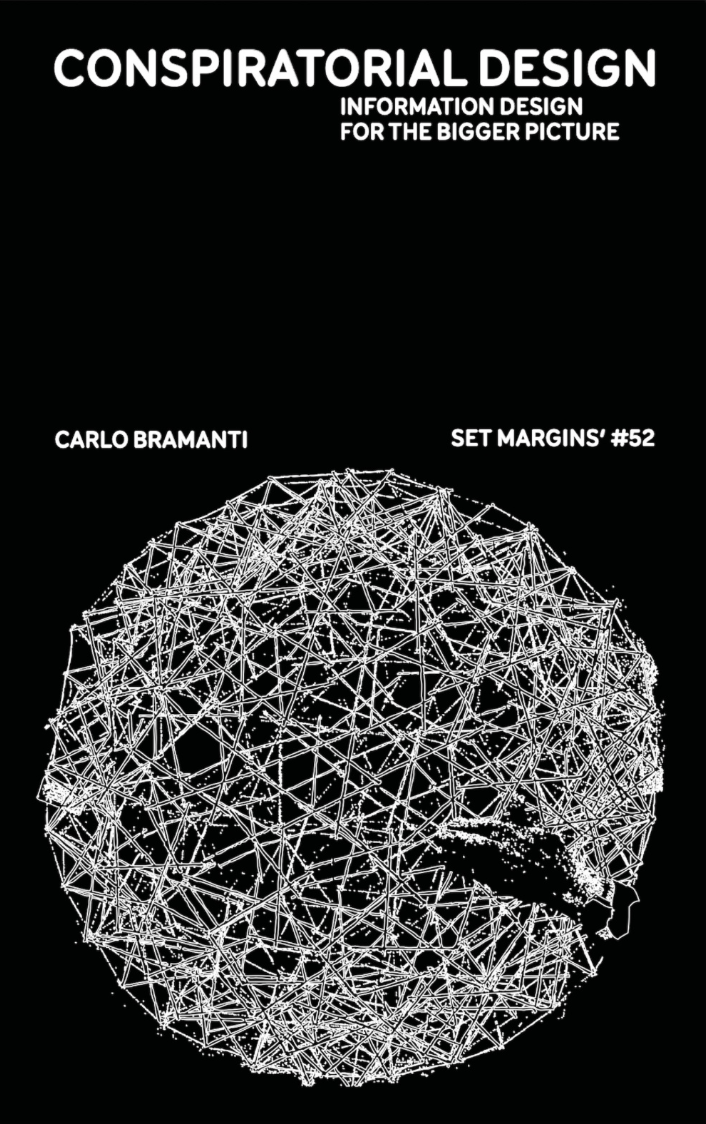
Data are not facts but arguments, so data visualizations are of arguments. The effort of information designers is to make a synthesis of a particular vision of the world.
Taking this position to its ultimate (il)logical end, author Carlo Bramanti investigates the shady relationship between information design and conspiracy theories. The conspiratorial, Bramanti argues, haunts design in its paradigms. With a vital urgency to see and share the bigger picture, this book probes the conspiratorial reality of design and investigates how communities try to give meaningful narratives to information to overcome the vertigo of complexity.
Published by Set Margins'
+
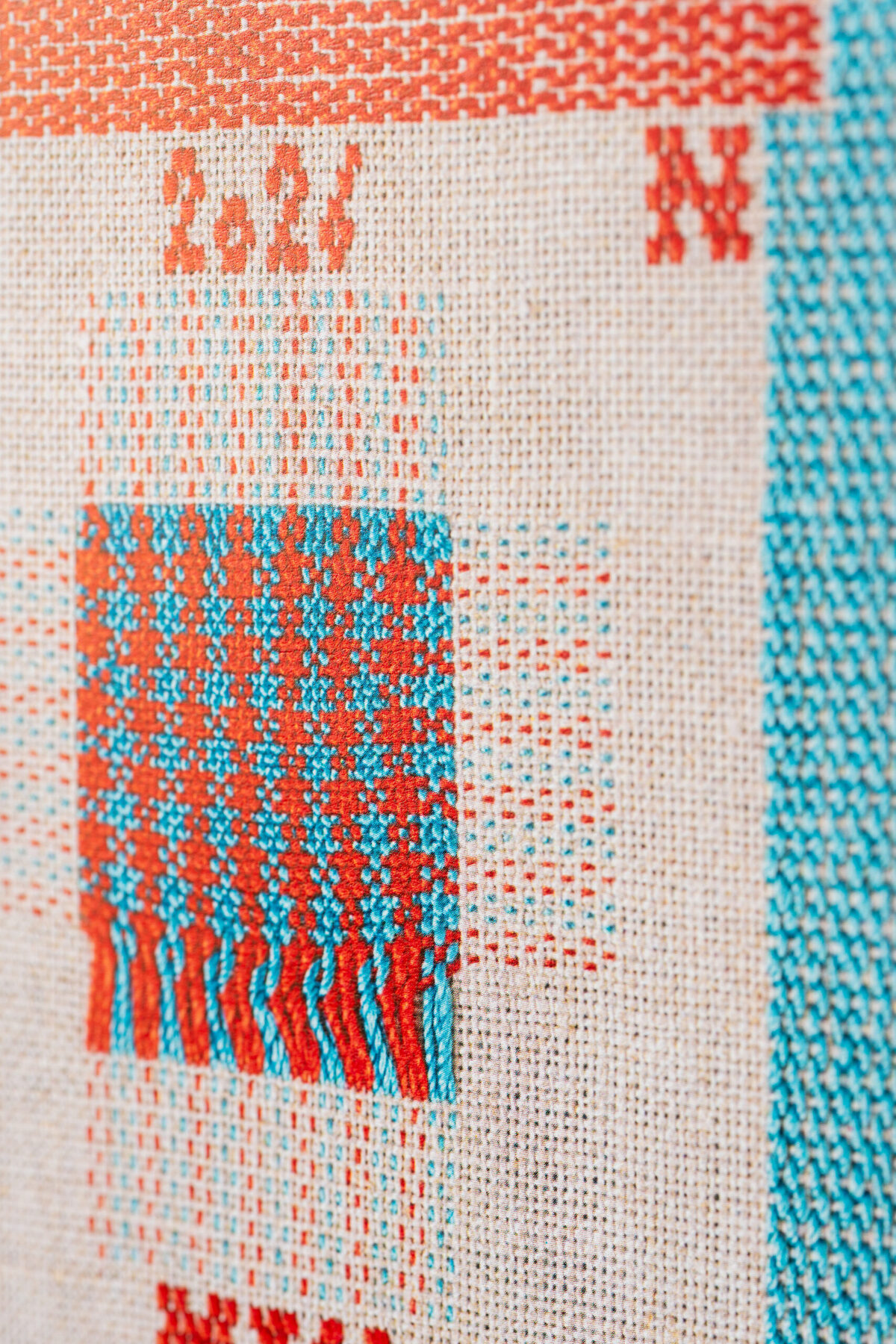
Calendar 2026: Quad explores darning, a textile repair technique where the surrounding area of damaged fabric is used as a loom to weave over.
Historically, darning was taught to students as a means to mend the cloth of various domestic items. Students would darn both practical and decorative patterns over the damaged sections of fabric, imitating different designs depending on their skill level. Such functional and ornamental darning patterns are utilised in Calendar 2026: Quad to produce the shapes that constitute its design.
The calendar takes its title from the word quad, a term that was historically given to a metal spacer used in letterpress typesetting and would later go on to refer to the spaces found in between type. Calendar 2026: Quad treats these spaces, along with areas around the edge of the ground fabric, as ‘holes’ or ‘damaged’ areas to darn. The embroidery has been photographed and offset printed with fluorescent blue, magenta, fluorescent yellow and black ink to a 1:1 scale. Each calendar is hand numbered and comes pre-folded in an envelope. Calendar 2026: Quad can be used as a decorative item or as a functional calendar.
+
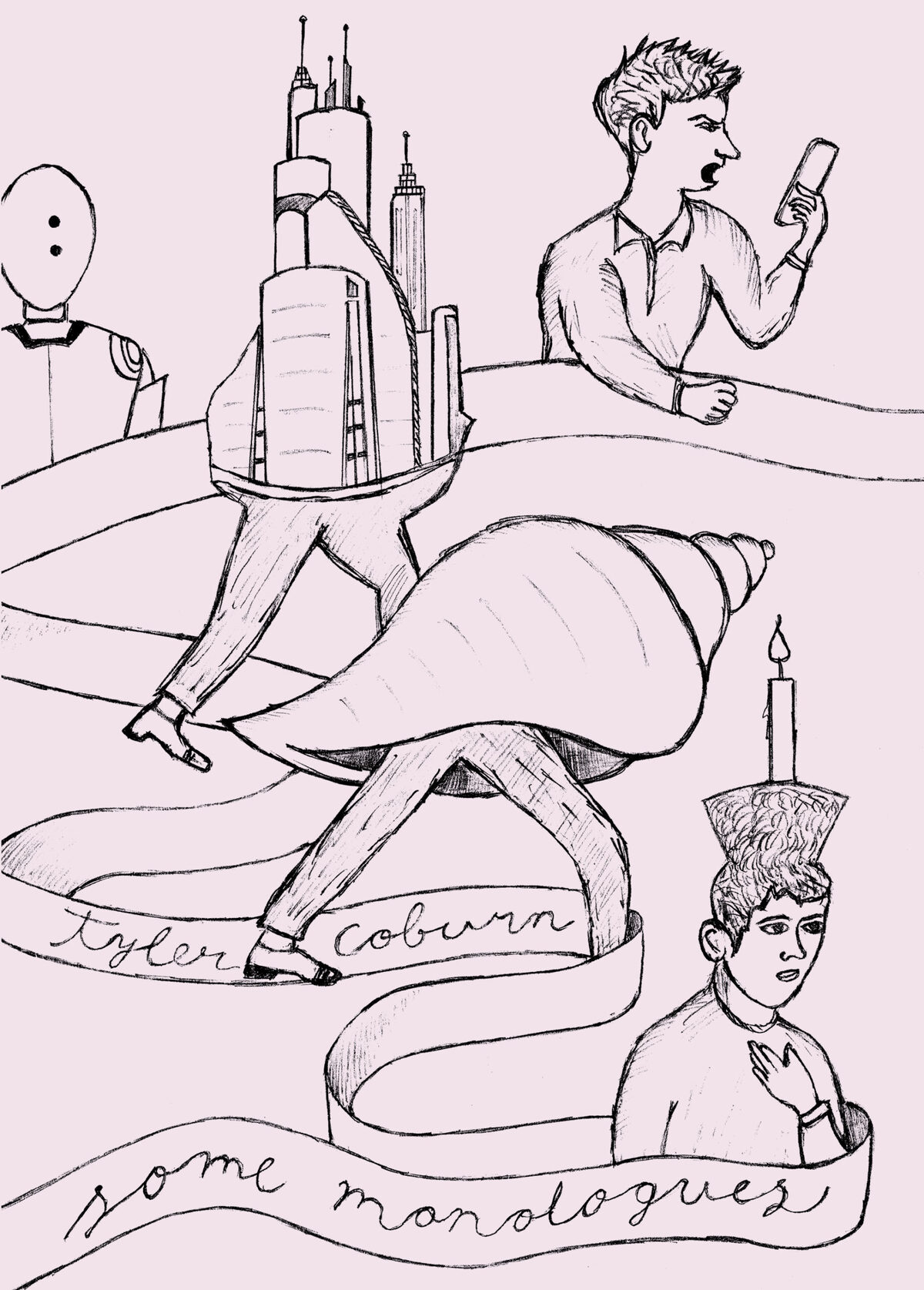
Join us for the release of Some Monologues by Tyler Coburn, a publication that gathers fifteen years of the artist’s scripts (Wendy’s Subway, 2025). On this occasion, Coburn presents a new monologue entitled People that draws influence from A Personal History of American Theatre (1980), a one-person performance by the American actor and writer Spalding Gray (1941–2004). Moving through a set of index cards bearing the names of plays he acted in, Gray told stories related to those productions, dwelling on events unfolding behind the scenes. As the order of the index cards was random, no two performances were ever the same. In Coburn’s version, each of his cards indicates the name of a person who has a role in the book: an academic he interviewed for a project, an amorous attendee to one of his monologues, his collaborator Susan Bennett (the original voice actress of Siri), a data center employee who insulted him, and more. People brings focus to Coburn’s many collaborators and the monologues they helped create.
After performing People, Coburn is joined in conversation by Karen Archey, Head of the Curatorial Department at Kunstsammlung , Düsseldorf, whose 2014 exhibition Art Post-Internet, co-curated with Robin Peckham at UCCA Center for Contemporary Art, Beijing, featured a version of Coburn’s monologue .
Working at the nexus of performance, art writing, and fiction, Tyler Coburn creates monologues that explore how the “I” is marked in speech. His myriad topics—alternate history, legal personhood, digital labor, and resonant frequency, to name a few—defy modes of presentation, often insisting on and social intimacy at the expense of conventional documentation.
Some Monologues collects, for the first time, the scripts of Coburn’s work from the past fifteen years, many of which have not previously been published. Accompanying them are texts by eleven artists, writers, curators, and scholars who experienced these performances firsthand, collaborated in their making, conversed with the artist about them, or share an interest in the subjects they engage. Written in theoretical, poetic, and registers, these contributions offer new perspectives on the monologue as an expansive and relational form.
Tyler Coburn is an artist, writer, and professor based in New York. He received a 2024 Andy Warhol Foundation Arts Writers Grant, and his writing has appeared in ArtReview, BOMB, C Magazine, Dis, e-flux journal, frieze, LEAP, Metropolis M, Mousse, and Rhizome. Coburn is the author of four books: I’m that angel (self-published, 2012), Robots Building Robots (CCA Glasgow, 2013), Richard Roe (Sternberg, 2019), and Solitary (Sternberg and Art Sonje Center, 2022). He has presented artwork at such venues as Centre Pompidou, Paris; Bergen Kunsthall; Hayward Gallery, London; Para Site, Hong Kong; and Kunstverein Munich.
Karen Archey is Head of the Curatorial Department of Kunstsammlung , Düsseldorf. From 2017 until 2025, she was Curator of Contemporary Art at Stedelijk Museum Amsterdam, where she cared for the contemporary art and time-based media collections. She has curated numerous group and solo exhibitions, often focusing on performance and the moving image. For the Kunstsammlung, she is currently preparing a solo exhibition by artist Jon Rafman and an playground by Sonia Kazovsky. Archey is an established writer and public speaker, contributing to conferences and exhibition catalogues in collaboration with museums throughout the world. Her essay-length book After Institutions (Floating Opera Press, 2022) examines museums as a rapidly changing public space subject to radical political and economic shifts.
...
To keep informed on new titles and our event program, please follow us on instagram.